
We hold high expectations for every child and focus on progress from individual starting points. When a child is identified as having SEND, support is tailored to their strengths and needs and coordinated by the Special Educational Needs and/or Disability Coordinator (SENDCo) in partnership with class teachers, families, and external professionals. In core subjects, including reading, writing, and mathematics, children are taught within their developmentally appropriate year group while building independence and secure learning habits.
Through inclusive teaching, children are supported to develop resilience, independence, and confidence. Staff engage in ongoing professional development to strengthen inclusive and neuroaffirming practice, and, when specialist guidance is needed, we work with education, health, and social care professionals to ensure support is coordinated and effective.
SEND Resources
Please look at the Padlet below for a bank of SEND Resources you can use at home.
Local Offer
Hackney Local Authority has published a Local Offer which sets out provision for children and young people with SEND, including those without EHC Plans (EHCP).
The key purposes of the Local Offer are to:
- Provide clear, up-to-date information about available provision and how to access it.
- Make provision more responsive to local needs by involving children, parents, carers, and service providers.
1. Overview of the School:
Gainsborough is a primary school in Hackney Wick, serving children aged 3-11. We are an inclusive learning community where all achievements are valued, and staff use neuroaffirming, strengths‑based approaches. We welcome all children, including those with SEND, and are committed to providing the right support so that pupils make progress from their individual starting points.
Gainsborough also provides specialist provision through The Aviary, our Social, Emotional and Mental Health (SEMH) Alternative Resource Provision (ARP). Pupils supported through The Aviary are educated alongside their peers in mainstream classes for the full school day, while receiving tailored SEMH support and interventions to meet their individual needs.
2. How the School Identifies SEND:
Concerns about a child’s development or progress can be raised by parents, carers, or school staff. When a concern is identified, the SENDCo meets with families to explore the child’s strengths and needs and to agree the most appropriate next steps.
A child’s needs may relate to learning, communication, emotional wellbeing, or their engagement with the curriculum and school routines. We place emphasis on early identification and work closely with families to ensure support is put in place promptly.
3. Areas of Need:
Many children have overlapping needs, but we identify a primary area of SEND for each child. In line with the revised Code of Practice (2015), this may be:
- Cognition and Learning: General learning difficulties (moderate, severe, or profound) or specific learning difficulties such as dyslexia.
- Communication and Interaction: Speech, Language and Communication Needs (SLCN), or difficulties with social communication, including Autism Spectrum Condition (ASC)
- Social, Emotional and Mental Health (SEMH): Challenges relating to emotional wellbeing, behaviour, or relationships.
- Sensory or Physical Needs: Difficulties with hearing, vision, mobility, or other physical needs that impact participation in learning.
4. Who to Contact:
The class teacher is the initial point of contact for responding to parental concerns. If you have further concerns please contact one of the following members of staff:
Assistant Headteacher and SENDCo – Ms Black:
sblack@gainsborough.hackney.sch.uk
Family Liaison Officer – Ms Harris
charris@gainsborough.hackney.sch.uk
5. Identification and Monitoring – SEND Support:
Once a child is identified as having SEND, we create a One Page Profile to summarise their strengths, interests, and needs. This helps all staff understand how to support the child across the school.
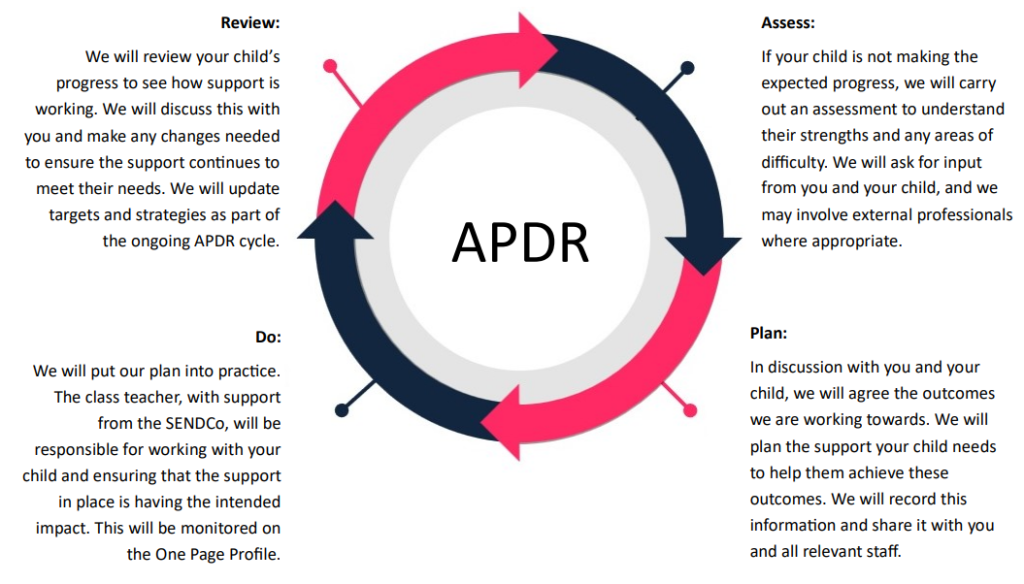
We use the graduated approach recommended in the SEND Code of Practice: Assess, Plan, Do, Review (APDR). This ensures that support is tailored, responsive, and regularly reviewed:
- Assess: Gather information about the child’s progress, strengths, and areas of need.
- Plan: Agree targets and strategies with parents/carers, the child, and staff.
- Do: Implement support in the classroom and/or through additional interventions.
- Review: Monitor progress and adjust plans to ensure support remains effective.
APDR Cycle:
Children’s needs are also supported through the Waves of Intervention model, which ranges from high‑quality classroom adaptations (Wave 1) to targeted small‑group work (Wave 2) and specialist input (Wave 3).
Waves of Intervention:
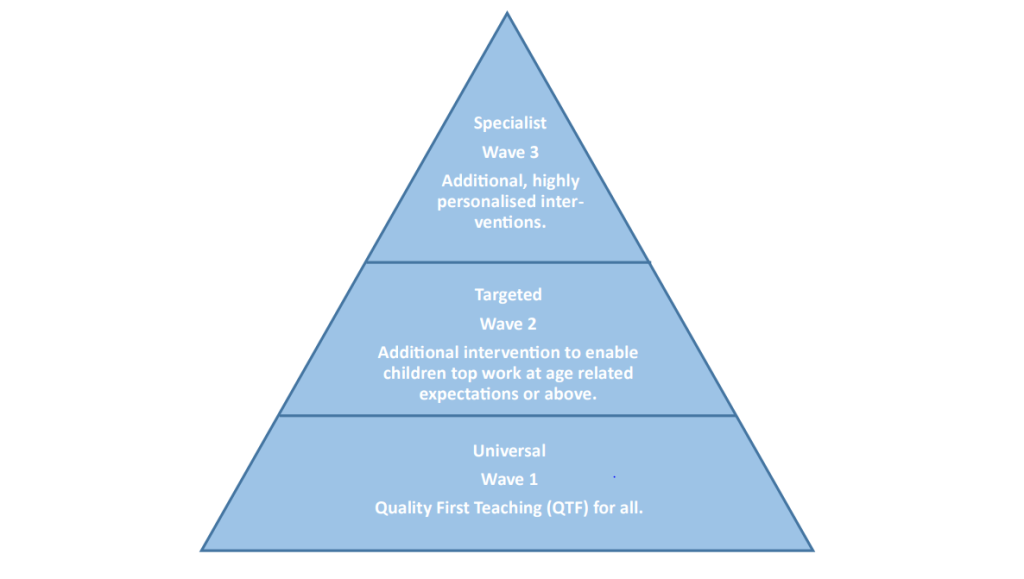
Wave 1: Universal Provision
- Adaptive teaching and clear scaffolding.
- Visuals, modelling, and structured routines.
- Reasonable adjustments made in class.
- Most children’s needs are met at this level through strong everyday practice.
Wave 2: Targeted Support
- Small‑group programmes (e.g., phonics, maths, language groups)
- Short‑term interventions to develop specific skills.
- Increased monitoring and review.
- This support supplements Wave 1 to help children make progress.
Wave 3: Specialist Support
- Specialist teaching or therapy input (e.g., Speech and Language Therapy, Occupational Therapy, Educational Psychology).
- May include an EHCP or multi‑agency involvement.
- This level provides support beyond what the school can ordinarily offer.
All support is coordinated by the SENDCo, ensuring a consistent approach for each child. Children receiving additional support are placed on the SEND register, allowing progress to be monitored and interventions reviewed. Support is flexible, with children moving in and out of support as their needs change.
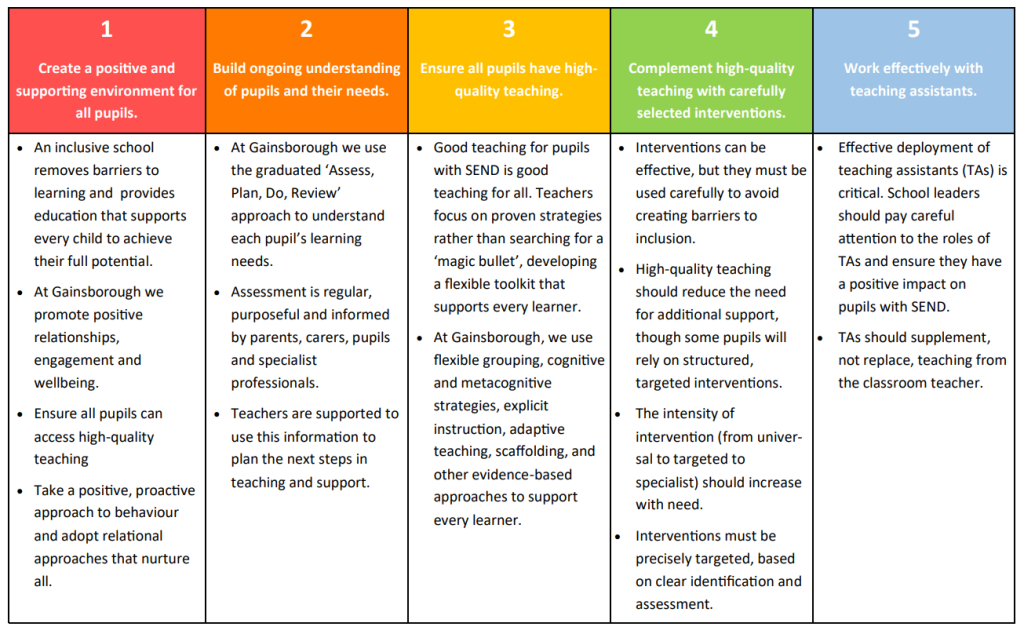
Best Practice for SEND: Our approach is informed by the Education Endowment Fund’s evidence‑based guidance for supporting pupils with SEND.
6. Education, Health, and Care Plans:
Some children require an EHCP if SEND support alone is not enough to meet their needs. An EHCP is a legal document that describes a child’s needs, sets out the support required from education, health and care services, and links desired outcomes to the provision in place.
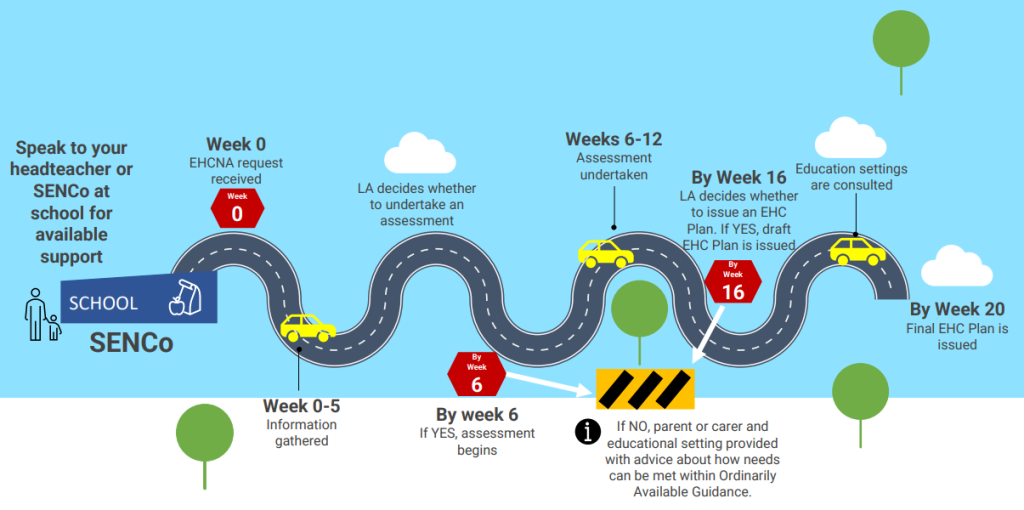
To decide whether an EHCP is necessary, a child will undergo an Education, Health and Care Needs Assessment (EHCNA). This assessment is conducted by the Local Authority and gathers information from the school, family and professionals to determine the level of support required. Not all assessments result in an EHCP; in some cases, the information shows that a child’s needs can continue to be met through the school’s existing resources.
The EHCNA process is completed within 20 weeks. During this time, the Local Authority gathers information from the school, family, and relevant professionals to assess the child’s needs and decide whether an EHCP is required. Once an EHCP is in place, it is reviewed annually during the Annual Review, to ensure that outcomes, support, and provision remain appropriate and continue to meet the child’s learning and wellbeing needs.
The 20 Week Process:
7. Interventions:
Interventions support children alongside high-quality classroom teaching and focus on specific areas such as phonics, vocabulary, social communication, or emotional regulation. Examples include targeted language and communication programmes, such as Colourful Semantics.
Children’s needs may be identified and reviewed using assessment and screening tools, including Verbo and the Boxall Profile, to ensure support is well-matched and effective. Interventions are time-limited, delivered by trained staff, and reviewed through the APDR cycle.
8. Specialist Services and Expertise:
We work with a range of education, health, and social care professionals to ensure children with SEND receive coordinated support. The SENDCo oversees all specialist involvement, ensuring that professional advice is embedded into classroom practice.
External agencies supporting our pupils include:
- Child and Adolescent Mental Health Service (CAMHS)
- CAMHS Worker in School (CWIS)
- Educational Psychology (EP)
- Hackney Ark Paediatric Service
- Hackney Children’s Services (Social Care)
- Mental Health Support Team (MHST)
- Occupational Therapy (OT)
- Re‑Engagement Unit
- School Nurse
- Speech and Language Therapy (SALT)
- Specialist Teacher
9. Staff Training and Continuous Professional Development:
All staff engage in professional development to strengthen inclusive, neuroaffirming practice. Each September, a Continuous Professional Development (CPD) programme is designed in line with the school’s SEND priorities. Training is delivered by experienced staff and external specialists, including Speech and Language Therapists, Occupational Therapists, and Educational Psychologists. We also share expertise across the Primary Advantage Federation to draw on effective, evidence-based practice and provide high-quality, inclusive support.
10. Medical Needs:
If a pupil has a medical need, a Medical Need Care Plan is completed. The plan outlines the support required during the school day and is shared with all relevant staff so that the child’s medical needs are understood and managed safely. Staff receive training where appropriate, and medication is administered in line with the agreed plan.
11. Accessibility:
We provide an accessible school environment to support all children, including:
- Fully wheelchair‑accessible school building
- Three wheelchair‑adapted toilets
- Ramp providing step‑free access to the building
- Toilet facilities with appropriate changing provision for young children
- Two sensory rooms
12. Transport:
Transport arrangements for children with SEND are managed by the Local Authority. Eligibility for transport support is considered as part of an EHCP or through transport applications made directly to the Local Authority. Families can find further information and guidance through Hackney Local Authority.
13. Further Information:
If you wish to discuss your child’s educational needs, request support, or find out more about SEND provision at Gainsborough, please contact the school office to arrange a meeting with the SENDCo.
Key Documentation
Gainsborough Accessibility Plan
Gainsborough SEND School Information Report (July 2025)
Useful Links and Resources
- Hackney Local Offer – Information about SEND services, support, and guidance across Hackney.
- SEND Code of Practice (2015) – Statutory guidance for organisations working with children and young people with SEND.
- Department for Education: SEND Guidance – National information on SEND support, EHCPs, and parental rights.
- IPSEA (Independent Provider of Special Education Advice) – Free, impartial legal advice for families.
- Hackney SENDIAGS (SEND Information, Advice and Guidance Service) – Support for parents and carers navigating SEND processes.
- NASEN (National Association for Special Educational Needs) – Resources, training, and guidance to support inclusive practice in schools.
- Get Hackney Talking – Speech, language and communication support for families and professionals in Hackney.